Lesson 10 of 18 · Hazards

Bends, hills and narrow roads

Read the shape of the road, the first bend, the width and separate priority signs.

Learn the signs

A41.1

A41.1 Højresving

Dangerous bend to the right

What it means
The road bends to the right. Adjust speed before the bend and keep within your side of the road.
Your action
The road bends to the right. Adjust speed before the bend and keep within your side of the road.
Common mistake
A triangular bend warning is not a blue mandatory turn instruction at a junction.
Full card and sources ↗
A41.2

A41.2 Venstresving

Dangerous bend to the left

What it means
The road bends to the left. Adjust speed before the bend and keep within your side of the road.
Your action
The road bends to the left. Adjust speed before the bend and keep within your side of the road.
Common mistake
A triangular bend warning is not a blue mandatory turn instruction at a junction.
Full card and sources ↗
A42.1

A42.1 Flere sving, det første til højre

Several bends, first right

What it means
Prepare for successive bends, the first to the right. Reassess speed and view throughout the sequence.
Your action
Prepare for successive bends, the first to the right. Reassess speed and view throughout the sequence.
Common mistake
The symbol gives the first direction; it does not mean every later bend turns the same way.
Full card and sources ↗
A42.2

A42.2 Flere sving, det første til venstre

Several bends, first left

What it means
Prepare for successive bends, the first to the left. Reassess speed and view throughout the sequence.
Your action
Prepare for successive bends, the first to the left. Reassess speed and view throughout the sequence.
Common mistake
The symbol gives the first direction; it does not mean every later bend turns the same way.
Full card and sources ↗
A43.1

A43.1 Indsnævret vej

Road narrows on both sides

What it means
The road narrows on both sides. Check the available width, oncoming traffic and any separate priority signs before entering.
Your action
The road narrows on both sides. Check the available width, oncoming traffic and any separate priority signs before entering.
Common mistake
The warning alone does not decide who has priority or instruct you to make a turn.
Full card and sources ↗
A43.1 warns that the road narrows on both sides. The lower UA43 plate states 3.5 m of free width; this is not a distance to the narrowing or a priority sign.
A43.2

A43.2 Indsnævret vej i venstre side

Road narrows on the left

What it means
The road narrows on the left. Check the available width, oncoming traffic and any separate priority signs before entering.
Your action
The road narrows on the left. Check the available width, oncoming traffic and any separate priority signs before entering.
Common mistake
The warning alone does not decide who has priority or instruct you to make a turn.
Full card and sources ↗
A43.3

A43.3 Indsnævret vej i højre side

Road narrows on the right

What it means
The road narrows on the right. Check the available width, oncoming traffic and any separate priority signs before entering.
Your action
The road narrows on the right. Check the available width, oncoming traffic and any separate priority signs before entering.
Common mistake
The warning alone does not decide who has priority or instruct you to make a turn.
Full card and sources ↗
UA43

UA43 Fri bredde

Free width at the narrowing

What it means
Read this with A43: the number is the free width of the narrowed road section. Assess your clearance and opposing traffic.
Your action
Read this with A43: the number is the free width of the narrowed road section. Assess your clearance and opposing traffic.
Common mistake
This width is not a distance to the hazard, and the plate does not decide priority.
Full card and sources ↗
A46.1

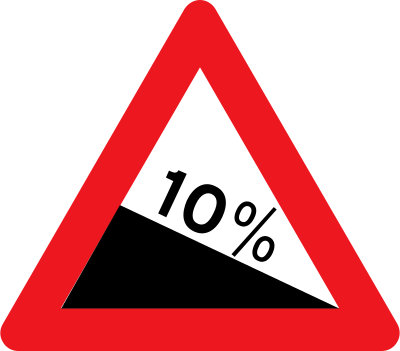
A46.1 Stejl nedkørsel

Steep descent

What it means
Reduce speed before the descent and choose a suitable gear to keep control. The percentage gives the maximum gradient.
Your action
Reduce speed before the descent and choose a suitable gear to keep control. The percentage gives the maximum gradient.
Common mistake
The sloping edge falls to the right: this is a descent, not the ascent of A46.2. The number is not a speed limit.
Full card and sources ↗
A46.2

A46.2 Stejl stigning

Steep ascent

What it means
Prepare for the uphill section, choose a suitable gear and watch for slower vehicles. The number is the maximum gradient.
Your action
Prepare for the uphill section, choose a suitable gear and watch for slower vehicles. The number is the maximum gradient.
Common mistake
A percentage on this warning is a gradient, not degrees and not a speed limit.
Full card and sources ↗
B18

B18 Hold tilbage for modkørende

Priority for oncoming vehicles

What it means
Give way to oncoming traffic at the narrow section. Do not enter if you would force it to stop.
Your action
Enter the narrow section only when you can pass without making oncoming traffic stop. Wait if needed.
Common mistake
The red arrow represents your direction; its size does not give you priority.
Full card and sources ↗
B19

B19 Modkørende færdsel skal holde tilbage

Priority over oncoming vehicles

Your action
You have priority over oncoming traffic, but wait rather than create a conflict with a vehicle already in the narrow section.
Common mistake
Having priority does not make an occupied or unsafe passage clear.
Full card and sources ↗

Recall: name each sign

Similar signs, different decisions

Look at the exact symbol first, then read the difference.

The triangle warns that the road bends right. The blue circle instructs a right turn; the road warning is not a junction instruction.

A43 warns of reduced width. B18 requires you to hold back for oncoming traffic; B19 requires opposing traffic to hold back. The narrowing sign alone gives neither direction priority.

The black edge slopes down in A46.1 and up in A46.2. The percentage gives the maximum gradient, not an angle in degrees or a speed limit.

What would you do?

Answer without looking back. Your first check is kept as your result. This is practice, not an official exam.

Lesson result

Previous lesson09 · Passing obstacles and sharing pathsNext lesson11 · Road surface, works and wind
Sources and review date

Reviewed: 2026-10-17. Study explanations are our wording; use official rules and your instructor’s guidance.

Road markings order 425, 13 April 2023

Færdselsstyrelsen — category B, May 2026

Danish Road Traffic Act 118, 12 January 2026